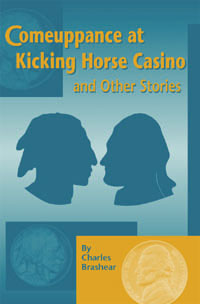
Comeuppance
at Kicking Horse Casino and Other Stories
from the Author's Introduction
This collection of stories is a mix of historical and
contemporary fictions about Native Americans. The historical
stories provide a background for the contemporary stories,
so that the entire collection becomes a loose chronicle
of the Native American experience since the European
settlement of North America. A wide range of tribes
is represented—Blackfoot, Powhatan, Cherokee, Creek,
Comanche, Lakota, Navajo, Ute, Keres, Acoma, Zuni, and
an unnamed southern California tribe. Each story highlights
some individual's quandary—and often alienation—in
negotiating and adapting to a face-to-face encounter
with the whites.
Until
very recently (until approximately the triumph of Indian
gaming), the dominant impact of the encounter has been
a limited destruction of the Indian—not always as extreme
as the suicide in "When the Fry-Bread Molders,"
but common enough to make that story a kind of keynote
to this collection, at least until the comeuppance at
the end. From the beginning, Native Americans have been
invited and/or forced to join white culture and have
see-sawed back and forth, as "Chanco" wavers, between
a passionate attempt to embrace white culture and an
equally passionate alienation from it. Some tribes and
some individuals have undergone a transformation of
the myth by which they live into something more harmonious
with white culture, as in the Cherokee transformation of
myth in "It's What We Want," a fiction based
closely upon historical fact. This evolution of consciousness
has allowed some tribes and individuals to assimilate
more successfully than others. Other tribes have preserved
or reinvented their cultural integrity, as in "Tell
Them We Have Started the War," where Indian traditions
remain triumphantly opposed to and unreconciled with
white culture.
And
yet, assimilation (a recurring theme in this book) has
been the effect, the subtext, of our history, and the
school has been its primary instrument. Almost half
of these stories involve the effect of school upon Native
American children—some from Indian boarding schools,
some from church schools, some from public schools,
all destructive in some ways, enabling in others. The
boarding school rape of both mind and body is, to me,
the shrewdest metaphor for what the white man has done
to the Indian. Some children—Jimmy Lame Crow, Maria
Has-Red-Shoes, Tommy Turtleback—are destroyed by school
experiences in different ways. Others—Eddie NightWalker,
Dillie Ci-yah-n-ree, Betjegen, Billy Duc-Doc—learn
to make profitable use of their school experiences,
even if the blessing is mixed.
Several
of these stories involve mixed bloods, products of Indian-white
marriages, a situation which nearly always generates
divided loyalties and identity crises. In "A Hunting
Story," the old man is still trying to deal with
a youthful violation of his cultural loyalty to an Indian
grandmother. In "Rough Creek, Texas," a young
girl is thrown into an identity crisis by the discovery
that she had such an Indian grandmother. In "Return
to Zuni," the tribe is the problem, rejecting Zima's
identity until the old grandmother comes forward to
endorse his loyalty and identity. Even the coach in
"When the Fry-Bread Molders" finds it sometimes
difficult to deal with his divided loyalties.
Another
facet of family is the continuity of generations. "Betjegen"
and "Return to Zuni" illustrate reintegration
of an individual into family after some time of assimilation.
"Ghost-Face Charlie" illustrates the destructive
aspect of that reintegration, while "Chitty Harjo"
shows beneficial results of a cross-cultural integration.
One segment of "Comeuppance at Kicking Horse Casino"
touches on the older generation's perception of continuity
and change.
Two
of the stories involve pyschological projection. Jackie
Bullbreath fills her anomie, not with cookies and milk,
but with her vicarious projection of her consciousness
into the lives of other people. It is not her fault
that she fails to assimilate; the fault lies with the
shortcomings of the white culture she is exposed to.
Jake Backturn, driven by his insecurities and guilt,
is slowly becoming Chitty Harjo, the fallen hero. He
is progressively taking Chitty's place in the family,
on the stomp ground, even with Chitty's girlfriend.
His projection of himself into the personality of Chitty
Harjo is a sort of reverse assimilation.
The
characters in "Dillie's Den," "Betjegen,"
and "Cowboy" have worked their way through
assimilation and have rediscovered at least some of
their native heritage, partly through a limited rejection
of white culture.
Table
of Contents
Author's
Introduction
When the Fry-Bread Molders
Chanco
It's What We Want
Tell Them We Have Started the War
Hiss-Til-Toyoo
Rough Creek, Texas-1888
A Hunting Story
Maria Has-Red-Shoes
Tommy Turtle-Back
How Beans Make Decisions
Ghost-Face Charlie
Dillie's Den
Betjegen
Cookies and Milk for Jackie
Chitty Harjo
Tour of Acoma
Return to Zuni
Cowboy
Comeuppance at Kicking Horse Casino
|